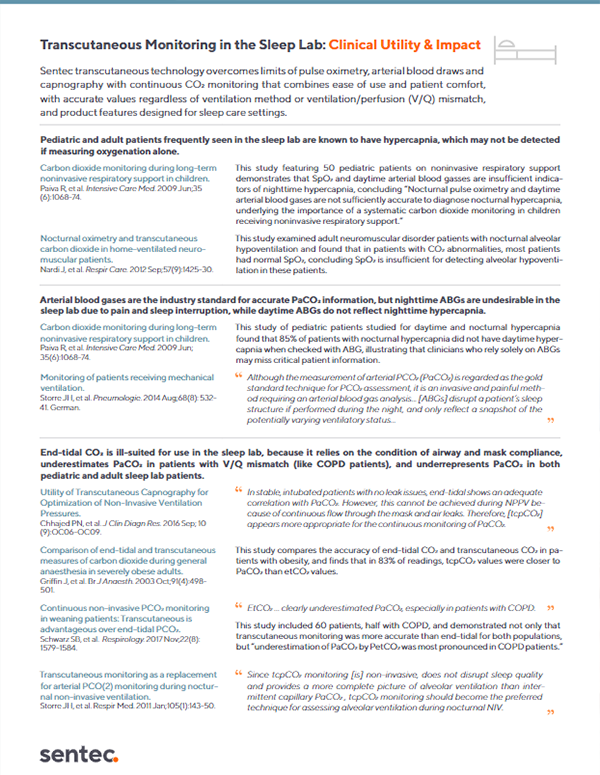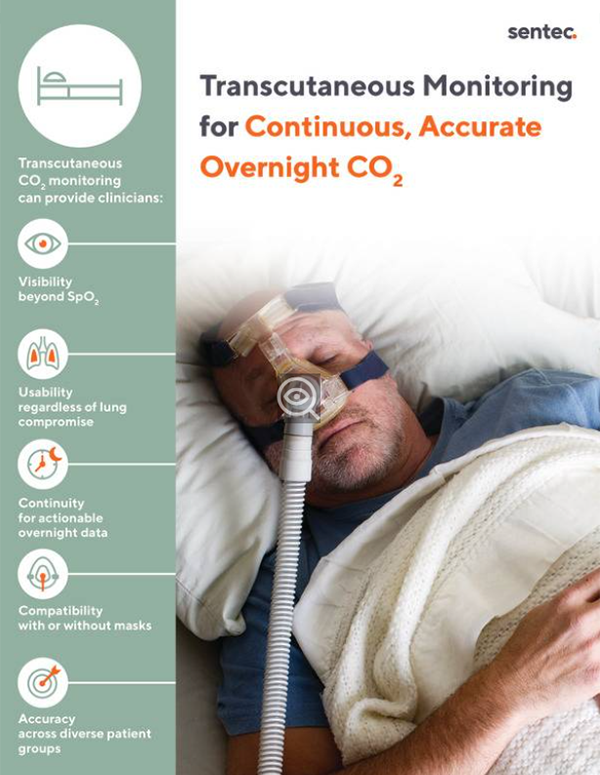

Diagnostic sleep medicine teams face particular challenges in the sleep lab, including trying to safeguard patient sleep and acquire quality data throughout the night. It is critical that their tools support these goals. Many sleep labs use end-tidal CO2 to monitor ventilation; however, this method presents a variety of challenges in this population.
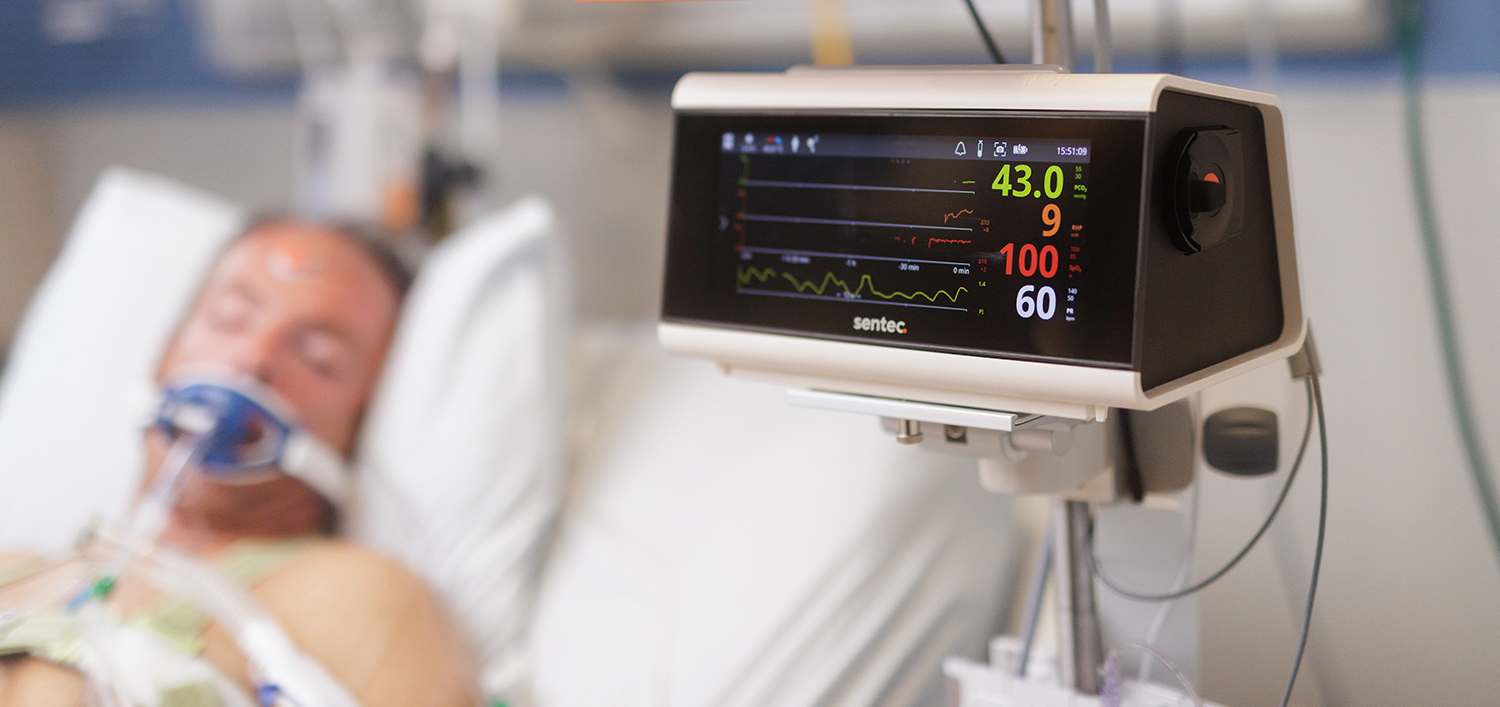
With product features designed for the sleep lab, the Sentec Transcutaneous Monitoring System combines ease of use and patient comfort with accurate values regardless of ventilation method or ventilation perfusion (V/Q) mismatch.
 Smart Cal-Mem
The unique V-Sign™ Sensor allows the sensor to be disconnected from the monitor for up to 30 minutes — without the need for recalibration. This can facilitate easier overnight monitoring, allowing for bathroom breaks, repositioning, and other interruptions.

 Up to 12 hours of monitoring
A single calibration enables all-night monitoring with site times of up to 12* hours.
Recommended 8 hours; 12 hours max
 Membranes last 28 days
Long membrane life supports workflows and cost management by allowing for longer periods between sensor maintenance.
 Useful data
Sentec technology connects to a wide range of patient monitoring, data management and polysomnography systems. Only stabilized values are reported to these systems, supporting better data management and analysis. Learn more
 Suite of attachment solutions
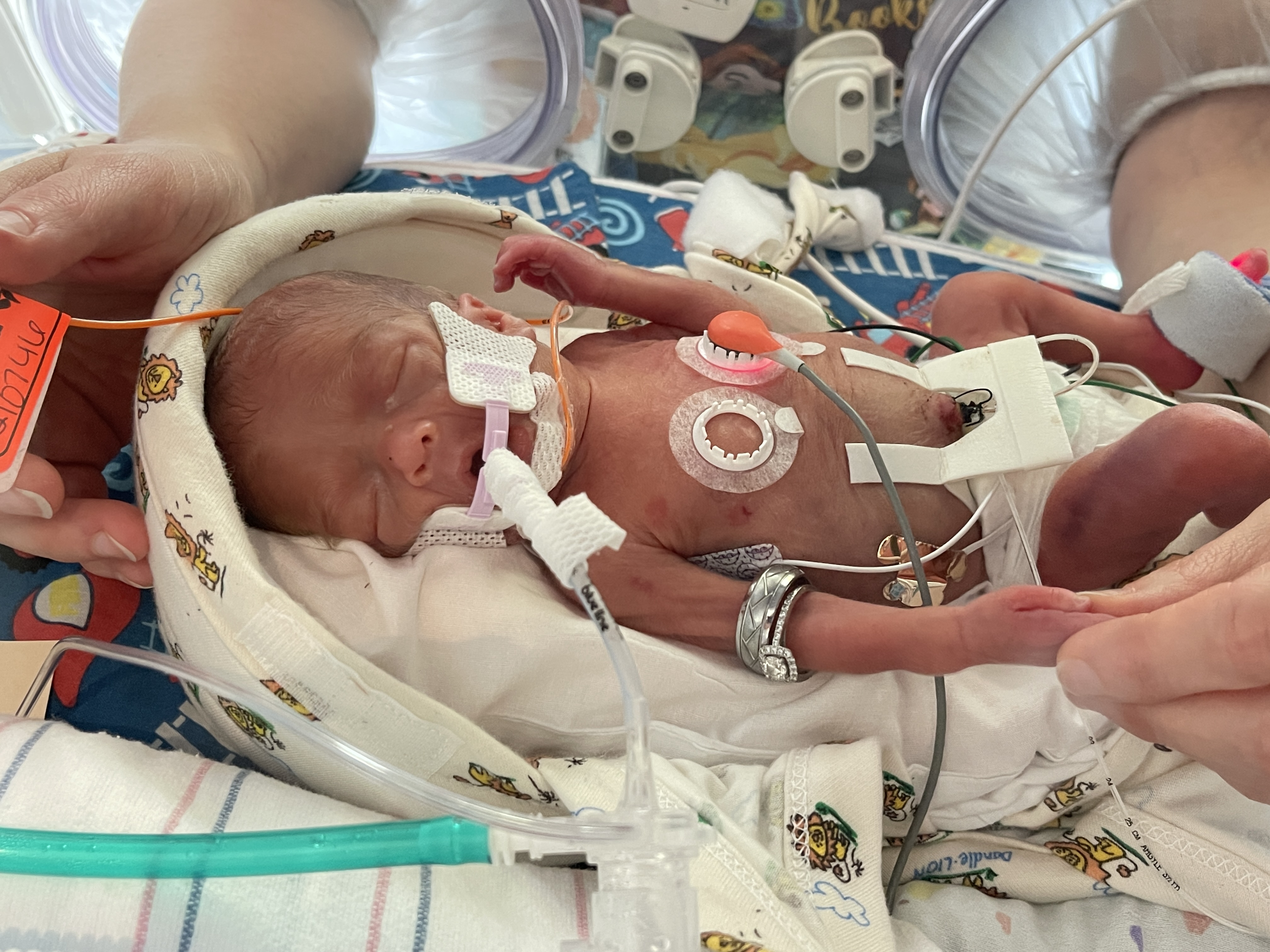
With a variety of attachment options available, the Sentec Transcutaneous Monitoring System is designed with sleep lab patients in mind.

Ear Clip
supports monitoring that is unobtrusive to sleep.

Multi-Site Attachment Ring for Mature/Intact Skin
is an all-purpose ring that utilizes an acrylic-based adhesive.

StaySite™ Adhesive
supports monitoring that is unobtrusive to sleep.

Single-use contact gel
supports a quality seal between skin and sensor; single-dose format supports infection prevention protocols.
 Sleep-Friendly Cables
Cords are long,* flexible, and allow the sensor to rotate freely within attachment solutions. These features support better sleep monitoring, allowing patients to move without disruption.
*multiple sizes available: 59.1”, 98.4”, 295.3”

 Dimmable display
The Sentec Transcutaneous Monitoring System features a monitor that can be fully dimmed to support better sleep.
 Silenceable alarms
Alarms can also be silenced/disabled, preventing patients from being disturbed during the night.
 Baselines
Caregivers can set a baseline that will appear continuously while monitoring, allowing for real-time analysis of changes throughout the night.
Dimmable display
The Sentec Transcutaneous Monitoring System features a monitor that can be fully dimmed to support better sleep.
Silenceable alarms
Alarms can also be silenced/disabled, preventing patients from being disturbed during the night.
Baselines
Caregivers can set a baseline that will appear continuously while monitoring, allowing for real-time analysis of changes throughout the night.
 Included reporting software
V-STATS™ software is included with the Sentec Transcutaneous Monitoring System. This allows clinicians to:
- Download, manage, and analyze patient monitoring data.
- Configure monitoring features that are otherwise inaccessible.
- Create customized monitoring profiles and reports.